Tuesday, September 14, 2010

Lit Rehab: Learning after Education

You could say that my senior year of college was my first real experience with hitting walls that confronted and disarmed my reality, made me into someone I was not. It was a test of integrity between societal conformity and self-preservation, trying to find that crevice wherein I could link my passion with what I was forced to do, to dispel monotony and complete a task I normally hated in a way that I could bear it. Ah, academics. It was in these months that I would lose the thick of myself, the core of my passions tossed aside for the sake of a finishing line. Rather than enjoying reading, it became “how many more pages do I have until I finish this?” Rather than write freely, I tensely stared at the new open Microsoft Word document that glared me down like an executioner.

I realized my dilemma with reading and writing became an intricate series of cause and effects, about how dangerous and simultaneously safe the academic world is. While I love learning, and would certainly consider myself a scholar – I’ve always loathed school and many people can’t understand that distinction. But it was in that distinction I lost myself, to be redundant: I was trained in my Alpha Female fashion, in the way Pavlov would know best – every book became a bell hitting an internal alarm, every phrase sought an answer to an essay question. I’d propel myself towards projects, wanting to read numerous books when I only had time for one. As time churned away, my migraines increased and my patience decreased – and I sabotaged the things I loved for a grade, to keep honors status, to graduate early.

Did the ends justify the means?

It is months later, and my head is still reeling in tension, searching for a deadline that was once there yet no longer visible – a self-inflicted worry. Every book is latched to a judgment, a due date, worrying for my future every time I pick up a book. To turn the things I love into a verifiable career, master’s thesis, time is ticking – you’re 21 and you haven’t accomplished enough yet.

I remember how I sought books for their imaginative refuge - to make me whole, to fulfill the honest yet unheard parts of myself I felt were threatened that needed some sort of knowledge hearth to supplement the insecurity. I sought liberation. And I think of people I know in prison right now, famous people I’ve known of that have been imprisoned in the past, and even the fictional manifestations of this situation – real: Martin Luther King Jr. and Malcolm X, fictional: V for Vendetta. How literature serves as a tool for imaginative escapism at first, but eventually transforms into a mode for realistic escape – an empowerment, a tool for enrichment. It was in watching V for Vendetta that the irony struck me – how I became a prisoner in a different way, perhaps the way society would want me. Manageable.

For, besides reading troubles, the academic system had also managed to destroy my creative writing by destroying the source: my emotions became completely unsafe. By attempting to follow the system and get things done as quickly as possible, my emotions imploded upon themselves within my last year of undergraduate studies, and then slowly burned out more and more. I had realized that in order for me to get through the rest of college, I needed to stop caring.

My emotional schema has changed dramatically from the impact. I’ve become more aloof, solid, and motionless. Angry – direct and focused instead of bottled in and unruly. It cuts at the source of everything, but runs deep in every single capillary. I seek to micromanage my emotions, a simultaneously soft and jagged form of sorrow. I touch my emotions enough to know they’re there, but not firmly enough to unleash them. I’m not comfortable enough to share. I splinter off and carry the thought that my own dilemmas are my own and are useless for talking about unless others share the grief currently, unless it can be used constructively, for good and healing. I’ve retreated to a world that is as hollow as a clock, listening to the mechanisms churn while the surroundings change correspondingly. I live so quietly now. I do not seek to argue my life to others as I find it hard to justify my own notions – not because they aren’t valid, but because I know they are things no one wants to hear, and that they will bat it out of their heads because it makes them uncomfortable.

I let others live their lives as I live my own. I exist in a self-imposed solitude. Writing exposes vulnerability, seeks empathy – I keep a safe distance from both of those things now, and maybe that’s the dilemma, the incapability of wanting to describe the slow, dissolving crush of reality upon a tiny human, one speck in the universe, trying to make a positive difference upon our very humanity. And so I only argue the facts, the struggles worth fighting for more than the justification of my only life – I stand firm behind on feminism, and advocate for sexual assault survivors – these issues are bigger than me, and I will not let them be denied voices. Does this imply I’ve let myself be silence and denied? I’m not really sure.

John Gatto, author of “Weapons of Mass Instruction: A Schoolteacher's Journey Through the Dark World of Compulsory Schooling”, would likely find this hilarious and perilous – a well-meaning girl who loves books and challenging authority can no longer read without getting stressed, and thus does not read. How I was regimented out of feeling and writing. How true education became dismantled, wherein learning became trite rather than rebellious, and facts fell into the background as I did not learn them. The standardization and regimentation became the perfect weapon towards dissolving me as it does other potential activists and radicals. In his book "Weapons of Mass Instruction," he argues the point that the current educational system is in fact designed to dumb us down. And arguably, many newspapers have recently reported the decline of creativity. It is not hard to imagine why: I can report firsthand that it’s hard to attempt the psychological unraveling of core anxiety responses. To now turn towards my bookshelves full of unread books and think: “How can I make you safe again?” It makes me nervous that they’ve been able to take away my books from me psychologically, make them inaccessible. So what is left?

“Lit Rehab,” I joke to a friend – a slow progression back towards the literary and creative extensions of my root passions and motivations. It begins slowly: I can now write personal blog entries… which is a step up from being stuck in the groove of academic papers (although very far from actual journal entries and creative writing), I can now read 6 pages of a book/a long article in a newspaper/other blog entries – which is substantially better than panicking and not even touching a book, right? I make minimalistic attempts, I remind myself to breathe. I dance, I sing, I try to imagine taking the world by storm, I tell myself: imagine their reactions if I was full of breath, if I was truly living through passions. How easy the rebellion in educating yourself is: the power I could bring to the world by educating myself on the things that matter to me most. I try to overcome the fear slowly – write a little bit everyday until the emotions kept inside unwind upon the page, pick up a book of quotes to read – small bites of inspiring witticisms to consume. It is trying to learn, once again, for learning’s sake.

Sunday, September 5, 2010

you have eye contact, but there's no emotion in your eyes. the question is though, why modeling?

I can't tell if this is the same person who initially commented on my modeling or not, but regardless, I'm both disconcerted by your comment/question and compelled to thank you for bringing it up. It forces me to deal with something uncomfortable in several ways. I thought about what my answer to this question was before I even went to type it out. My initial thought response felt a bit jarring to me.

1. "Because emotion doesn't have a place in modeling." 2. "Because then I'd be vulnerable."

I'll address number 2 first.

I think why I've always preferred writing is how emotion can remain so recklessly contained. I could control it while simultaneously feeling untamed. For years I hated myself for my intense emotions, until a person stepped into my life and really made me realize the value of them. Until then, I found that I always felt the need to wrangle them back in. And I have no trouble expressing them in personal relationships, as I once did. I suppose, though, it doesn't however remove the sentiment that I have trouble expressing emotions physically, confessing them in a way that could be captured and viewed or heard (singing). It triggers something deeper. Because I know I'm a landmine. And if I were to show my emotions lately, it'd be more hurt and anger more than anything else - the emotion lining the double-edged sword of my delusional amount of hope for myself and this world.

Within the past year, I grew more distanced from my emotions due to the fact that as I became more engrossed in academia, as I tried to fight for what I believed in - the more I held myself out there hopefully, the more the world sought to shoot me down. For every "delusional" burst of hope I provided, backed even with statistical facts, people sought to tell me all the reasons I'd fail. While trying to repeatedly tell myself that those who have failed at their dreams will attempt to make me fail at mine (because misery loves company and there are too many jealous people who don't want to see others succeed when they can't), I began tucking the most intimate parts of myself deep inside myself. I stopped reading for months and months, I stopped writing creatively, I became afraid to sing - I kept waiting, apprehensively, for people to continue to take away from me what I loved. I've learned time and time again how making your emotions open lends you to vulnerability and manipulation. So, I've been hibernating and growing stronger and am slowly emotionally unraveling, now setting all the building blocks to take the world by storm.

So, you're right, perhaps I should find some more photographers to explore a range of emotions with. Especially because that's how I ended up getting into modeling to begin with.

"Why modeling?"

You could call it an exercise in physical therapy honestly. I began Rolfing sessions (structural integration) the same summer in order to due with the strong disconnect I had with my body due to prior trauma. My dissociation was beginning to infest all the areas of my life - I couldn't make it to classes some morning because my knee would randomly give out, or my shoulder would allocate so much pain from taut muscles I thought I'd dislocated it, or I'd get triggered and curl into the fetal position; my love life would splinter as I'd splinter out of my body from one intimate touch from a guy; and it was brought to my attention I was routinely starving and dehydrating myself without realizing it. I began to realize how frequently and severely I was tuning my body out, how I was treating it as just a means to an end, a vessel. I used modeling as an excuse and an exercise to pay more attention to my body and take care of it further.

However, this brings me to the other disturbing thought - thought number 1. I didn't realize I'd gotten so wayward in the year of modeling I've done that I didn't even realize my thoughts were morphing. While my thought certainly does not apply to all forms of modeling, it applies to one of the types I'd gotten sucked into - fashion modeling. An intriguing jump from the "nude in nature" modeling which I started out with. I could go on a rant about typical fashion modeling in society, but I'll save it - because it's all very obvious and has been said before. But if you really want to get into my thoughts on modeling - personal versus societal, I suppose you could always ask me.

Ask me anything

Saturday, September 4, 2010

"That's So Gay" is NOT okay

So. I just happened to be looking up season 1 of Glee on Amazon.com because I'm mildly obsessed with it lately, and would really like to purchase the whole season. For some reason, I perused the reviews - maybe because I say 50+ reviews for a product that hasn't even technically been released yet... and I found a review that caught my eye:

"Ok its time to get something off my chest.
WHAT is wrong with people these days???????????
If you like this show your:

A. a teenage girl
B. have horrible taste in telivision (not that theres anything worth watching anyway)
C. a high school muical fan
D. GAY

This show is sooooooo stupid, no lie. Who likes this? How ?
This
Yesss to those who say I haven't seen the show with my own two eyes, I have. Unfortunatly I wish I had the 30 mins of my life back. Braking out into a sing a long every other second over nothing hmmmmm is this a Disney movie ................. I think not at least those are entertaining. The characters are not likeable at all, its just so built for this sad young generation its not even funny. This generation has the worst taste in just about everything :

Music
Movies
Tv
Etc.

And Iam 24 its not like Iam to far behind this generation but its just so pathetic.
Horrible show I would not watch another episode if I was paid to.
ANYONE with half a brain will steer clear of this shamockry of a show!!!"

Aside from the ridiculous amount of grammar and spelling errors, the implication that this show was horrible and ergo could only be liked by certain demographics such as "GAY," made me livid. Because it implied that every demographic listed was horrible or not worthy of value, ergo worth putting down - ergo turning "Gay," yet again, into an insult. When it shouldn't be. Ever. In a sense, listing "teenage girl" in the same insulting matter is just as bad. But "Gay" hit a trigger in me. I have a huge handful of friends that are gay, and they are perfectly wonderful people - more wonderful than most people, I would say, if only because they have to learn to confront hostility with kindness and are frequently forced to justify their sexual preference, which should not ever have to be justified to begin with. Love is love, and placing restrictive gender norms on it is foolish. Hating a person for a part of him/herself that he/she is intrinsically born with, just because it may be different from the norm, is ridiculous. To put it lightly. And then to use that difference to describe other things you can't deal with/don't like is even worse. It's sheer ignorance.

I'm essentially incoherently angry right now, so this blog entry isn't a very educated or well-thought attempt and perhaps I should leave it for Wanda Sykes to explain, because I feel she does it quite well:


And just to further my point and be increasingly obnoxious to the reviewer who will likely never see this blog post, I will conclude with a clip from Glee that is very appropriate to this situation:


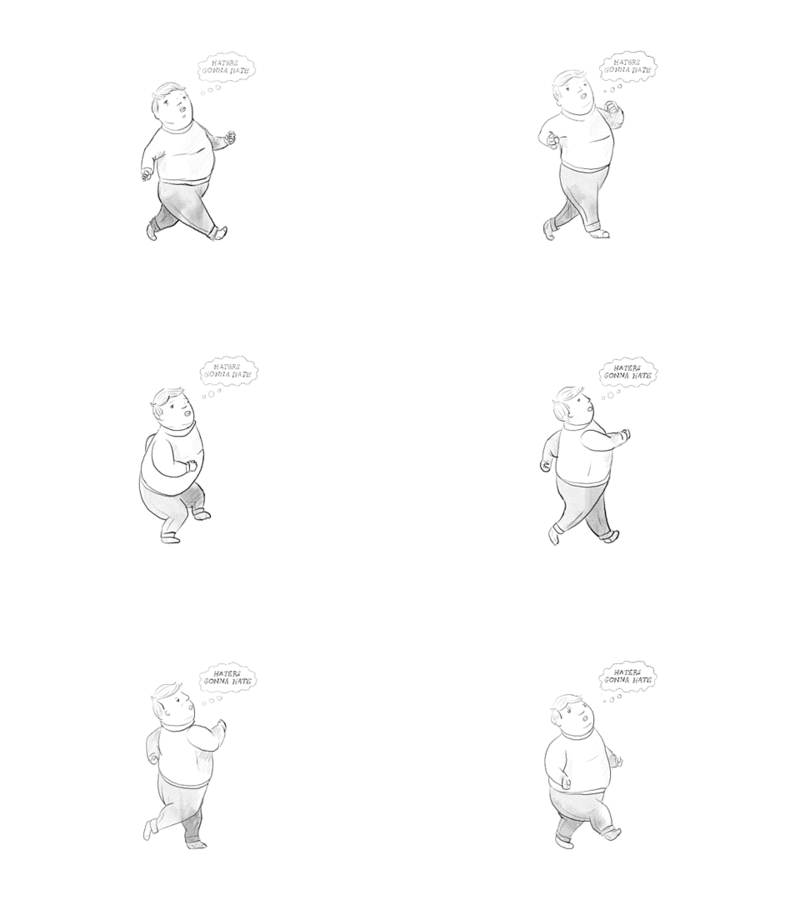
Haters gonna hate.

Friday, August 27, 2010

what does a young feminist look like? do they need to have a look?

No, I don't think they need to have a look or that there is "a look," but rather, many looks. I'm not sure there are any specific requirements to being a feminist (in my mind) other than trying to be sensitive to gender norms, striving towards gender equality in all forms (language, politics, economy, etc.), and simply being aware that you will always have more to learn. While the last bit can be said about anything in life, I've found that it is extremely important in feminism - particularly because of all the intricacies involved in feminism. It's a movement that really attempts to include more than exclude, and in order to do that we have to continually hone our sensitivities and be aware of our biases as well as be open to criticism. We have to be willing to continually transform ourselves so that we can create more safe places with equal playing fields. I know, for myself, I have a lot more to learn about feminism and women's history - but I could also say that about a lot of other feminists, not because they aren't well read, but because there are so many variants to be considered and voices to be heard, that it'd be naive to pretend that there is ONE look to feminism. And I think that's perhaps what feminism is - being aware of how many oppressed voices there are that need to be heard, and trying to be sensitive to all of them so that they may be heard. It reminds me of a quote that I (of course) cannot fully remember nor find on google, that basically says: do not help me just to help me or because it makes you feel better about yourself, I do not want that kind of help; but if you are here to help me because your liberation is linked with mine, then come stand beside me and we will fight together. And I think that is something that should always be remembered.

Ask me anything

Missconceptions of Feminism

I used to make fun of feminists. I don't know why I did, but I did. I think maybe it was because I didn't know what a feminist was exactly, and that the extent of my knowledge of feminism was the copy of The Feminine Mystique my close friend Diana was reading (which I still haven't yet read). And something about it seemed trite and passe, unwelcoming - I had visions in my head, like many other people do, of angry women with unshaved armpits, burning bras, and waving spatulas very angrily trying to get every woman out of the kitchen. Regardless, as a high school student, I got the feeling it wasn't safe nor was it cool to be one.

I only knew two people who could be recognized as feminists then - and only one of them self-identified as a "feminist," and despite how popular she was, people gave her a lot of shit for it. So I never learned feminism, didn't even touch it with a fifty-foot pole.

I grew up in a suburban town right outside of Queens, NY that's full of Irish and Italian Catholics, bars, and a very small minority population. To the outsider, my hometown may seem like a pleasant non-threatening place - a great place to raise the kids. Today when I try to explain my hometown, it's hard to explain the almost sinister undertones of conservative politics that bled through even to children. Among the most popular boys in our high school was a frequent joke (a serious joke) that a woman's only place of belonging was the kitchen, as if they knew best for women: a typical hypocritical form of dominance when I know for a fact that at least one of them couldn't even tell the difference between a tampon and a pad.

And there will be one scene that always haunts me when I think of gender norms at my high school, and how typical they all were. Right outside the cafeteria window, a male is yelling at a girl - he grabs her by the hair and whips her around, dragging her out of sight still by her hair, until we hear a car door slam. Nobody flinches to even help that girl, a younger guy sitting near us says "that's fucked up." I frown. Nobody moves.

When I train to become an advocate for sexual assault victims years later, I will learn this to be a prime example of the Bystander Phenomena. And I don't know if I should liken it to the Kitty Genovese case where every neighbor had assumed the other person was going to do something about it, or if I should liken it to pure apathy or pure fear. My roommate I have now couldn't understand this. As I try to explain to her bystander phenomena, and explain that we breed a society that works against sexual assault and rape victims, she doesn't get it.

But why wouldn't they believe them [the sexual assault victims]?

I shrug, "the society we live in. It all comes down to a Virgin/Vamp dichotomy. There's this really great book that talks about it, Virgin or Vamp: How the Press Covers Sex Crimes, that I used for my Feminist Sociolinguistics paper that talks all about how there are 8 factors that tilt a woman towards a "vamp" and less believed."

"If she knows her assailant; if no weapon is used; if she is of the same race, class, or ethnic group as the assailant; if she is young; if she is considered pretty; and if she is in any way deviates from the traditional housewife-mother role."

"Listen," I say to her, "I had a friend who was raped her first semester at college, and when she came home to tell her parents, they blamed her - and this is on top of the fact that she didn't even realize what had happened to her was rape, somebody else had to tell her. And this happens all the time."

Girls don't realize they're raped, and then the girls that are raped are too afraid to speak out - because the police are intimidating and hinder rather than help, because the rape kits are invasive and evidently will just sit around and not be used for evidence. And it's scary considering nationally 1 in 4 women will be raped or sexually assaulted in their lifetimes and 1 in 7 men will deal with the same, and the statistics could be even higher because it's been noted that at least 60 percent of women don't report their rape. I'm not good with math, but I don't like the implications of those numbers.

And it all links together, and it shows in our government, in our language, and even our day to day actions.

The first time I really began to delve into feminism is when I landed in my third college, at the end of my first (of two) years there. When I found, rather than 1-2 girls, a steady handful of women who proclaimed themselves as feminists and openly fought for women's rights. It was safe for me to be a feminist in this environment, and so I explored it. I ended up being the Featured Poet and lead organizer of the open mic night at Take Back the Night that year, an actress in the Vagina Monologues, took every training offered by the local Sexual Assault Services Organization, ended up being one of the lead members of the college's Feminist Voice, helped with the Clothesline project, became a lead organizer of Take Back the Night again, helped with the first ever Four Corners Pride festival, and so on and so forth. Even the current President of Feminist Voice thought I was a Gender/Women's Study major, and within that one year I had left at that college, I became best friends with even the prior Feminist Voice president. To everyone around me, it seemed as if there was never a point in my life when I was not a feminist.

At one point in January I updated my facebook with a link to a bunch of articles pertaining to feminism, I joked in the comments section of the last one "Don't mind me, just clogging up your news feed with feminist news," and one of my friends made some comment like Same old, aren't you always updating with feminist news? To put this transformation in perspective, I graduated high school in 2007, which means in three years I went from being a person who made fun of feminism to being in a situation where I'd be the first name to come to mind of many people when they were asked about feminists on campus.

As I switched gears in this rapid transition, I found myself confronting my old view points and some discriminatory view points I had never even considered. The feminist as man-hater viewpoint (one I used to believe) certainly came into focus for me as I began discussing Take Back the Night in my Evolutionary Psychology class, trying to get people to come, and one guy turns towards me with a decent amount of trepidation in his voice, "So, can I come?"

"Of course you can, men are certainly welcome to join us in Take Back the Night..."

"I mean... you guys aren't going to beat me up or? I mean... I'm not going to be yelled at?"

"You'll be fine, I promise."

That guy never showed at our march into town for Take Back the Night, however there was another guy who did show up and as he carried the sign with me, he noticed I was wearing heels and felt the need to ask (in a flirty voice), "So, I noticed you're wearing heels. Do you consider them to be a sign of oppression?"

"... No. I like wearing heels."

Exasperation, I've learned, alongside with anger, almost becomes a common state for me when discussing feminism with many people who aren't feminists. Not only because of when you endure situations like these, but also because of when you endure ones like my friend Amelia does. Like when she happened to get incredibly drunk one night and reveal to a whole bar that she was gay. An innocent enough event until the boyfriend of the friend that brought her home notices Amelia's collection of feminist books on her bookshelf and comments, "Oh of course she's a lesbian, there's no way a straight woman would have this many books on feminism on her bookshelf." Oh of course not, because who in their right mind would support feminism?

And this situation is almost matched in ridiculousness to another time she experienced very recently where she was road tripping with a friend. Because when she stayed with her friend's family in Texas one of them had commented something like, Well you're a woman, so what does your opinion matter anyway. Suitably enough, Amelia had a mental breakdown that night, internally combusted, and flew home the next morning towards safer territories.

And these are the times you have to take into consideration that it's not that there aren't young feminists, but perhaps they might just be in hiding. In discussing feminism with a professor, he mentioned, You know, there are a lot of people who are feminists and just don't realize it. I've done this exercise with classes before where I ask them: do you believe women should get equal pay? And they all agree yes. Do you think women should have the same political rights as men? And they all say yes. Do you consider yourselves feminists? And then all of a sudden, there are a lot less yesses. They get uncomfortable. Yet, they just stated that they believe women should have all the same rights as men - but they won't call themselves feminists.

Now, however, unlike this group of college students, I can safely and firmly say I'm a feminist. And I hope that people everywhere, too afraid and uncomfortable to before, will be able to say the same thing about themselves one day too.

Thursday, August 26, 2010

Women's Equality Day

Hello everyone! Happy Women's Equality Day!

In case you're too lazy to click the link or simply like consolidation,

What is Women’s Equality Day?

At the behest of Rep. Bella Abzug (D-NY), in 1971 the U.S. Congress designated August 26 as “Women’s Equality Day.”

The date was selected to commemorate the 1920 passage of the 19th Amendment to the Constitution, granting women the right to vote. This was the culmination of a massive, peaceful civil rights movement by women that had its formal beginnings in 1848 at the world’s first women’s rights convention, in Seneca Falls, New York.

The observance of Women’s Equality Day not only commemorates the passage of the 19th Amendment, but also calls attention to women’s continuing efforts toward full equality. Workplaces, libraries, organizations, and public facilities now participate with Women’s Equality Day programs, displays, video showings, or other activities.


Bueno! Considering my knowledge on feminist history is very limited in comparison to many I know, this blog entry is going to be a little bit more whimsical than some of my other entries. But perhaps it's good to embrace the fun side of it since today is a happy day (even though we do have a long way to go)! So, two fun videos I came across and some fun facts about my relation to feminism (and I hope you'll share yours too in the comment section):


Now, fun facts about me (because I know you're so enthralled):

Photobucket


1. When I was a child, I apparently loveeeedddd Wonder Woman. Although, for some reason or another, I had problems with similar sounding words. I'd run around the house yelling, "WHEN I GROW UP I WANNA BE WOMAN WOMAN." My babysitter evidently tried to correct me that it was Wonder Woman and not Woman Woman but my parents thought it was too cute to correct.

2. I think my favorite quote by a feminist, because it carries so much weight, is "Your silence will not protect you." - Audre Lorde. I love it for trauma-related reasons but it also carries a great deal of political significance to it too, don't you think?

3. Upon buying an incredibly awesome bumper sticker that says "EVE WAS FRAMED," I had decided to strategically place it under the bitten apple logo on my mac laptop. A lot of people caught onto it and appreciated it, and I remain to be fairly amused by the placement. My fellow feminist friend, Amelia, now owns this laptop and carries it around with pride. I bought another EVE WAS FRAMED bumper sticker and it proudly sticks to my bookcase (an equally good place to put it I think).

4. I have a "Haters Gonna Hate" shirt if only because Jessica Valenti has that little guy struttin' away on her formpsring account, and because really, feminists have to deal with so many Haters.

5. When I was a child, Annie Oakley was my heroine. I begged my 5th grade teacher to let me write a report on her. I still think she is one incredibly badass woman.

6. The reason I got into feminism, ironically, was through a English class I took in Spring 09 entitled Rise of Raunch where we studied the impacts of porn upon American society. And, being an English major at the time, I decided to use that class to study how the words "slut," "cunt," "bitch," and "whore," could be used as sexually empowering words for women rather than derogatory words. I became so intrigued by this one final research study that I turned it into a SOC 499 Independent Study course entitled "Feminist Sociolinguistics," and wrote a 47 page paper on it. One day, I will hopefully write a book about this.

7. I model in my spare time - and while this can be seen as somewhat... hypocritical, I find it to be empowering. I use modeling as an attempt to truly focus on my body and its feelings, per se, so that I grow more connected to it. As a trauma survivor, it becomes easy for me to dissociate from and ignore my body. Modeling forces me to focus on my body and notice its strengths and weaknesses, and reinforces that its okay for my emotions and body to link. Naturally, I will and have run into photographers who do not have good intentions and have not treated me the way I should've been treated - and I never work with them again. And I would caution and advise other girls who want to get into this sort of thing to approach it the same way. Always always remember how valuable you are.

8. My dream, as many people know, is to work with sexual assault survivors and provide writing therapy for them - and hopefully, through this, increase awareness of sexual assault and change the language dynamics of how we approach a woman's sexuality. Essentially, the mission of this blog, my grad school studies, and my career.

Hope you enjoyed the random media and life facts! I would love to hear any of your stories, favorite quotes, favorite feminists facts, or quirky feminist tidbits! Happy Women's Equality Day!

Stream of Consciousness: Word, Body, and Politics

TODAY, MY FRIENDS, IS A FABULOUS DAY.


Not only is it Women's Equality Day (which I will post on later), but I have also been accepted into Goddard College as a candidate for a M.A. in Individualized Studies w/ a concentration in Transformative Language Arts!!! Things are IN MOTION and it feels awesome.

In that vein, this blog post is going to have a little bit more to do with my ambitions and my writing side. A little while ago, my friend Jess mentioned she was looking for people to write guest posts at her blog, Mal-diction: the literary bitching and moaning of an English graduate student, and so, I offered myself up since I used to be an English - Writing option major at my undergraduate college and still have strong ties to literature. However, I did it with a twist - while it's easy, with my background, to still snipe about grammar, syntax, and imagery - I wanted to share my newfound love of the intricacies and impact words have upon our lives with an audience who might appreciate them but not be aware of them. In short, I chose to write about what I used to call: "Creative Writing and Social Change," and what Goddard eloquently rewords as "Transformative Language Arts."

The post, entitled "Stream of Consciousness: Word, Body, and Politics" can be seen here at Mal-diction, but here's a teaser:

"While I was always aware of the importance of the subject I would eventually declare my major, it only came into my consciousness slowly. Step one: being a English-writing option major with a long, devoted history to creative writing. Step two: being immersed in grays. Step three: taking "ENGL 267 PERSUASIVE WRITING" and choosing to research and argue "A Million Little Pieces" by James Frey as a valid work of creative non-fiction that should not be disregarded due to fact changing. Beginning to study the impacts of trauma upon memory recall, and thus, memoir writing. Step four: declaring a psychology minor. Step five: working on my final research project for my "ENGL 417 RISE OF RAUNCH" class wherein I studied sexually-charged words attributed to and reflective of female behavior such as "bitch," "slut," cunt," "whore," etc. and how women could use them as a positive empowering source. Discovering how the word "cunt," for example, used to be used as a title of respect for women in Ancient Egypt - and how one girl took her experience being gang-raped and called a "slut" to liberate herself sexually.

Step underlying all of this: beginning to validate the sexual, emotional, and physical abuse I had endured as a child. And analyzing the way it impacted by body, my language use, and my perceptions of all of these.
"

I hope you head on over there to read it!

In the meantime, some other fun English-related tidbits:


I Write Like by Mémoires, Mac journal software. Analyze your writing!


I found out I evidently write like David Foster Wallace (by entering in my guest blog post from Mal-Diction), who according to Wikipedia, has been heralded as "one of the most influential and innovative writers of the last 20 years." This clearly means when I get around to publishing a book, I'm going to revolutionize the world as we know it. :P Or at least for a little while.

I've also, this morning, adopted a word at SavetheWords.org, a website designed by the people behind the Oxford English Dictionaries who are eager to keep older words in circulation so that they don't die out.

In case you are curious I have adopted (and am thus attempting to bring back into circulation):

1. tortiloquy: (n.) dishonest or immoral speech
2. essomenic: (adj.) showing things as they will be in the future
3. omniregency: (n.) state of complete authority
4. resarciate: (v.) to make amends

Words are so fabulous. I hope you join in on the mission.